
Trace Robertson County Former Owners by Transfer
Pin down the parcel's current identity first. The Robertson County PVA is the place to begin. The assessor lists the owner of record along with the parcel number and valuation that anchor everything after. From there, work backward through the deed records the County Clerk holds. Give every transfer in your log its own row. A shared surname proves nothing until the acreage, legal description and deed reference all belong to one tract. So make those details earn their place before you trust the chain.
| Time layer | Coverage | Custodian or channel | Ownership clue |
|---|---|---|---|
| eCCLIX document index | 1980–current stated; verify by type | County Clerk online route | Grantor, grantee, date and reference |
| Deed index and deed microfilm | 1867–1939 | Robertson Public Library | Earlier book/page links and deed text |
| Assessor books | 1872–1882 | Library Kentucky Room | Assessed-name and tract clues |
| Tax lists | 1883–1891 | Library Kentucky Room | Year-to-year taxpayer continuity |
| Older books and plats | Beyond verified web coverage | County Clerk counter/request | Legal description and parent tract |
For a modern transfer, enter through the Clerk's online-records page. For nineteenth- or early-twentieth-century owners, begin with a known deed's source-of-title citation, then request the cited book or use the library's dated run. Tax books corroborate assessment patterns but do not convey title.
The Robertson County Clerk online-records route is the verified entry point for the modern former-owner chain.
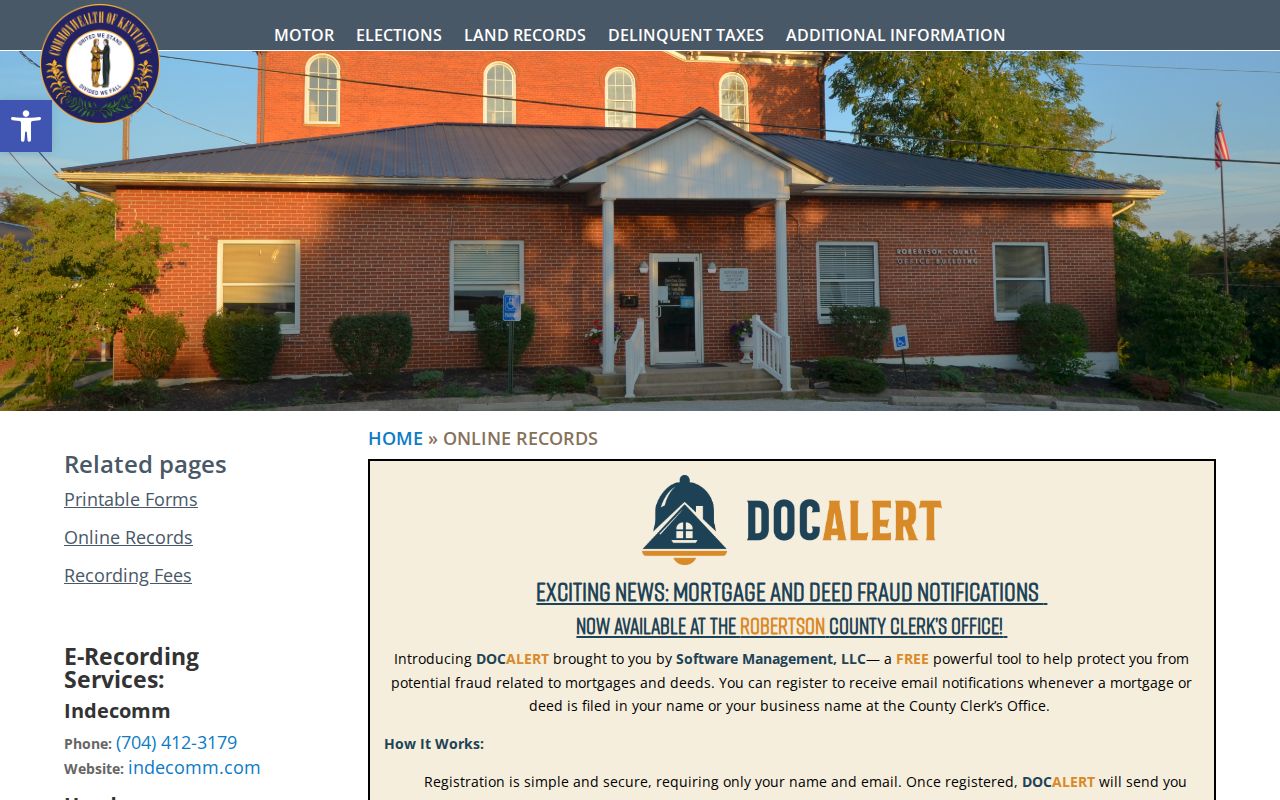
The Clerk's online-records page points researchers to recorded instruments. Older ownership links still call for books, microfilm or a written request to the office.
Build the Robertson Deed-Chain Timeline
| Transfer date | Grantor → grantee | Instrument | Official reference |
|---|---|---|---|
| Newest verified date | Prior owner → present grantee | Read deed type exactly | Copy book/page or number |
| Earlier acquisition | Earlier grantor → prior owner | Read deed type exactly | Follow source-of-title citation |
| Next earlier link | Repeat with matching tract | Note estate or court transfer | Move into books when needed |
Log the details as you go. For each transfer, save the execution and recording dates, the consideration paid, acreage, the parcel or tract description, any spouse or fiduciary capacity, and every exception or reservation buried in the text. Label the two dates separately, because they often differ. A deed recorded years after signing tells you nothing certain about when possession actually changed hands, so the recording date alone should never close the question.
Note: Follow the land description as well as the people; recurring names can hide a mismatched parcel.
Walk Robertson County's Deed Chain Backward
The eCCLIX index works by name rather than by address. Its Robertson form does not publish a complete control list, so treat grantor, grantee, instrument number, book and page, document type and date range as fields to test yourself. Robertson residents get five free searches a day through the personal route. Image and printing charges may apply on top of that.
- Identify the correct parcel and present assessed owner with the PVA; save any deed or last-transfer reference.
- Find that owner's acquisition deed, confirming the legal description instead of relying on the name alone.
- Read the grantor. That party is the next former owner candidate.
- Search the grantor as an earlier grantee, narrowing by date and testing initials, spouses and spelling variants.
- Repeat while every description identifies the same tract; log splits, consolidations and reserved acreage.
- At the web cutoff, carry the last book/page reference into deed books, microfilm or an archival request.
- Grantor / grantee
- The conveying party and the receiving party named in a deed.
- Chain of title
- The connected sequence of transfers affecting the tract.
- Reverse index
- An index route used to find when a named party acquired an interest.
- Warranty / quitclaim
- Deed forms with different covenants; neither label alone proves an unbroken chain.
The 1867–1939 Robertson Microfilm Bridge
The Robertson County Public Library genealogy collection holds deed indexes and deed microfilm covering 1867 through 1939. This is the bridge most family historians need. Its Kentucky Room also keeps a microfilm reader and printer. It holds newspapers, census and cemetery material, obituaries, and a family-data cabinet spanning roughly 725 families. Those extras matter. They can separate same-name previous owners. They also expose estate, road-name or family-transfer context that deeds alone leave silent.
Let the index hand you a book and page, then read the deed itself. Genealogy and newspaper evidence never substitutes for the instrument. Write down how each name is spelled. Note whether the person appears as grantor, grantee, heir, spouse, commissioner or personal representative. For possible state holdings, gather the county, series, year, names and your last citation. Send them to the Kentucky Department for Libraries and Archives.
Robertson County's 1867 Starting Boundary
Robertson County was born on August 1, 1867, Kentucky's 111th county. That fact shapes every title search here. A tract's ownership history can predate the county itself. The chain may cross into predecessor-county deed books. The library's Robertson microfilm begins at county formation, not at each tract's first private ownership. When the earliest Robertson deed cites an older instrument or patent, save that citation. Then work out which county held jurisdiction on the date it was recorded.
Historic maps and plats add geography where deeds lean on creeks, ridges, roads or neighboring landowners instead of a numbered address. Mount Olivet, Sardis, Piqua, Johnson Creek and Ogden Ridge work well as search localities. They also serve as landmarks. None is a confirmed subdivision. Only a recorded plat or deed establishes the legal identity of the land.
Estates That Interrupt a Clean Owner Sequence
Death breaks the tidy seller-to-buyer rhythm. Ownership may jump for many reasons. A will or a probate order may explain it. So may an affidavit, a commissioner deed or a personal-representative deed. Search the County Clerk for the recorded land instrument. Contact the Robertson County Circuit Court Clerk about any probate file. The county publishes no online case search of its own.
Kinship and ownership are separate questions. An heir's name in a file does not prove the person ever received this tract. Only an order, a deed and a matching legal description connect them. A historic tax list can tie a name to an assessment. It will not show when or how title actually passed.
Old Roads and Address Variants in Robertson Deeds
An address-only search can lose former owners fast. Rural route names, highway numbers and 911 addressing all change over time. Search "Mt. Olivet" and "Mount Olivet" both. Preserve the exact road or creek wording. Ask the PVA whether today's parcel descends from a named parent tract. For Sardis, settle whether the land sits in Robertson or Mason County before choosing a Clerk. The postal city decides nothing about recording jurisdiction.
With a metes-and-bounds deed, compare acreage, directional calls, corners and adjoining owners line by line. A sketch or GIS map can orient you. It is not a survey. When land was divided, give each child parcel its own timeline branch. Keep it out of the parent tract's sequence.
How Far Back Robertson Ownership Records Reach
Clerk documents run from 1980 to current, subject to the eCCLIX county-and-document availability screen. The library microfilm reaches farther, covering Robertson deed indexes and deeds from 1867 through 1939. Ask the Clerk about books in between and older still. An empty online result means only one thing. The name, date or document never surfaced in that single query.
Coverage boundary. Online deeds are stated as 1980–current; use courthouse books, 1867–1939 library microfilm, or an archival request for earlier prior owners.
Robertson County ownership chains can run all the way back to a patent, a partition, or a conveyance filed in a predecessor county. Not every Robertson parcel has one tidy first deed. That gap is normal, and it should not end the search. The right place to stop is where the evidence shows the next link sits in another jurisdiction, a different collection, or a book that no longer exists , not where a web search simply runs dry.
Lawful use. Trace former owners for property history, estate work and purchase diligence; never use owner information to track, intimidate or harass a living person.
Keep a source log for every link in the old-owner chain. Each row should capture the county. It should also list the record book or instrument, the page, grantor, grantee, execution date, recording date, and deed type. Add the source-title reference too. Include the part of the legal description that proves the tract match. Estates, court sales, partitions, and boundary corrections can interrupt the ordinary sequence. When one does, cite the probate or court case. But remember the filing itself is not the conveyance.
Historic assessment and tax books offer another way to test the timeline. The Robertson Public Library holds assessor books for 1872-1882 and tax lists covering 1883-1891. A name in those pages is a dated assessment clue, not proof of title. Compare acreage, district, value, and adjoining owners across volumes. A sharp shift may point to a sale, an inheritance, a split, or a correction. Go back to the deed and probate books. Learn which event the property record actually supports there.