
What Robertson County Property Tax Records Show
No single desk holds the whole tax story in Robertson County. Trace each field back to its source office, and pin every figure to its tax year before you rely on it.
| Field | What it shows | Where to obtain it |
|---|---|---|
| Owner, situs and parcel | Assessment account and January 1 listing | Robertson County PVA |
| Land/improvement/total assessment | Components used for taxation, if provided | PVA parcel card |
| Exemption or classification | Taxable treatment | PVA |
| Current bill and receipt | Amount, bill number, collection stage and payment | Robertson County Sheriff |
| Delinquent bill/certificate | Post-April 15 account and purchaser status | County Clerk |
| Tax rates | County, school, city and district levies | Kentucky DOR rate book/taxing body |
Look Up a Robertson County Assessment Before the Bill
Start with the Robertson County PVA, which tracks ownership changes, fair-market-value assessments, exemptions, GIS maps, building characteristics, photographs and sketches. The office publishes no online parcel-search form. Call (606) 724-5213 or visit 26 Court Street instead. Bring an address, owner, road or landmark, parcel number, deed reference and the tax year you need.
- Ask for the parcel card and current assessment year.
- Confirm situs, mailing address and owner of record.
- Record land, improvement and total values separately when available.
- Check classification and exemption status.
- Carry the parcel and bill number to the Sheriff for payment information.
Tax terms. Assessed value is the figure placed on the roll, while fair cash value follows Kentucky's willing-buyer, willing-seller standard; an exemption lowers the taxable assessment, and a tax lien secures unpaid tax.
The January 1 Snapshot Explains Name Differences
Kentucky puts a January 1 date on every taxable real property assessment in Robertson County. Because of that snapshot, records can disagree without either one being wrong. A deed may be recorded in March. Yet the seller's name still appears on that year's tax bill. The Sheriff notes that bills are built from PVA information. The office also tries to mail a new owner. A sale recorded after January 1 simply falls outside the assessment window.
So build the timeline in order: deed execution, deed recording, the PVA ownership update, the January 1 assessment, bill issue, then payment or delinquency. For a property records search, the newest recorded deed settles who owns the parcel. The tax record names who owed that year's tax bill. No Robertson County source publishes a standard number of days for the PVA refresh. So treat any figure you hear as unofficial.
Robertson County Sheriff's Four-Part Collection Calendar
The Sheriff's tax page lays out an unusually clear collection calendar for Robertson County taxpayers.
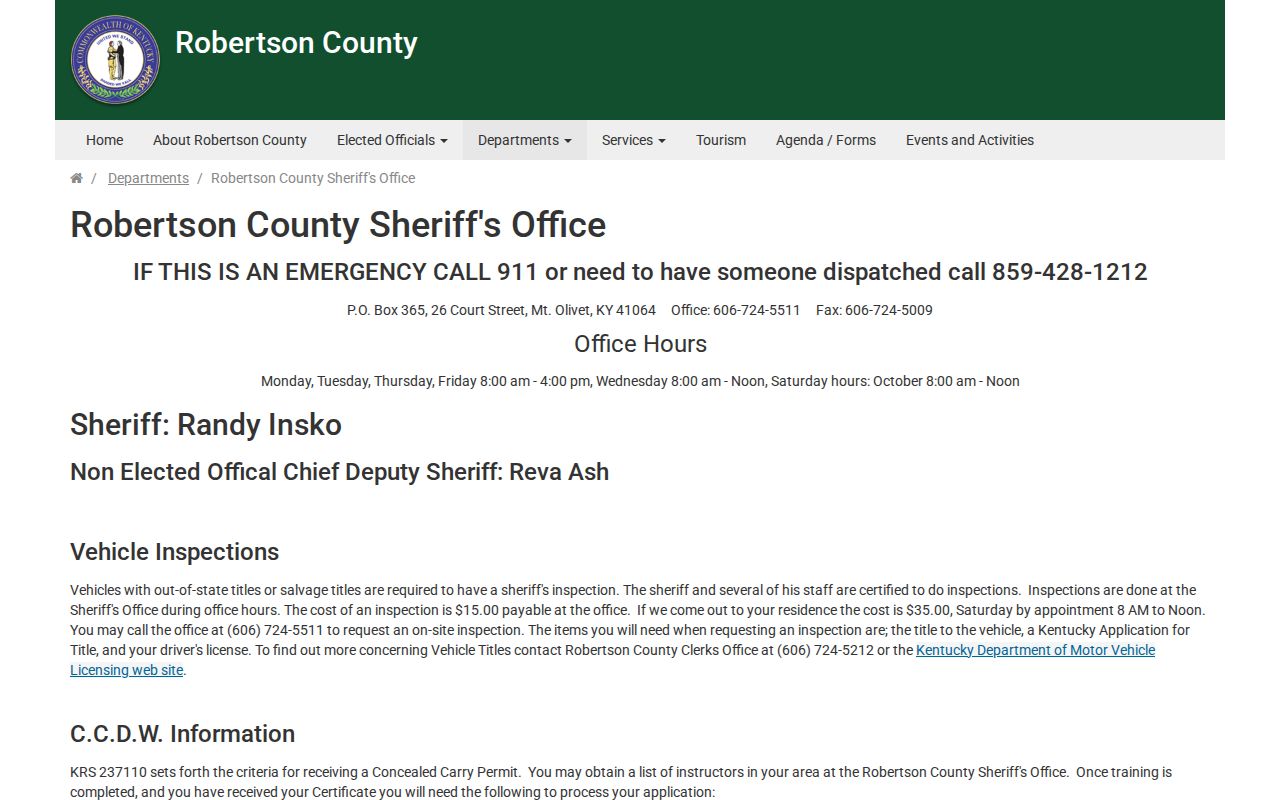
That page is the source for the current bill. Once April passes and the account goes delinquent, the Clerk becomes the contact instead.
| Period | Status | Custodian |
|---|---|---|
| October 1–November 1 | 2% discount | Sheriff |
| November 2–December 31 | Face value | Sheriff |
| January 1–31 | 5% penalty | Sheriff |
| February 1–April 15 | 21% penalty | Sheriff |
| After April 15 | Transferred as delinquent | County Clerk |
Bills generally arrive by late September or the first week of October. If nothing shows up by mid-October, call (606) 724-5511 for a duplicate.
Ways to Pay and Document a Robertson Tax Bill
Payment options run through several channels. Mail the bill to the Sheriff at P.O. Box 365, Mount Olivet, KY 41064, pay in person at 26 Court Street, use a telephone credit or debit card with the published 3% surcharge, or use the outside drop box. Cash works only in person. Checks, cashier's checks, money orders and cards each fit their applicable channel.
Include the bill number with any payment. Walk-in customers get a receipt, and mail users can enclose a self-addressed stamped envelope for one. Keep that receipt with the year and parcel. A paid bill proves payment; it is not a deed or title certificate.
After April 15, Ask the Clerk About Delinquency
After April 15, unpaid bills move from the Sheriff to the Robertson County Clerk, where they can be purchased as certificates of delinquency.
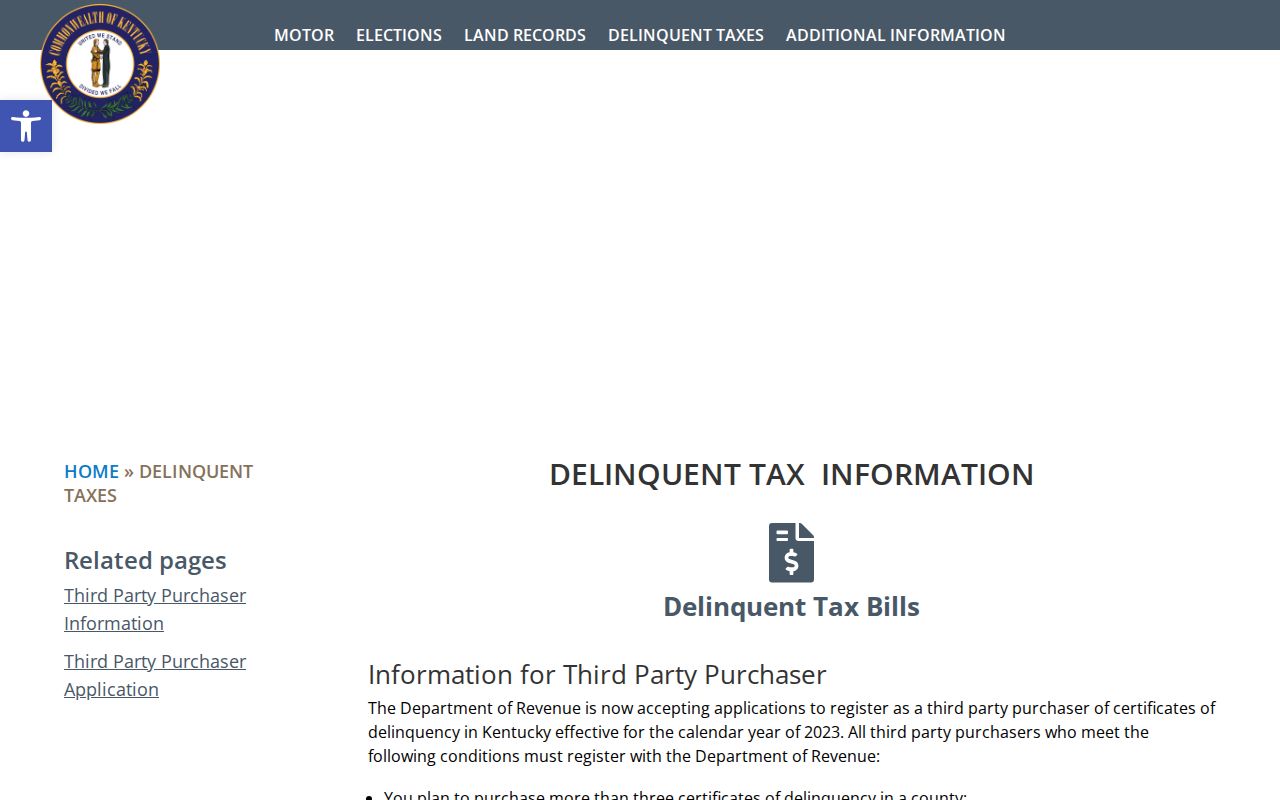
Call the Clerk at (606) 724-5212 for a payoff figure, certificate status and sale information. The office offers no public bill-search form.
Third-party buyers face registration rules. Anyone planning more than three certificates in one county, more than five statewide, or over $10,000 invested must register with DOR, pay the stated $250 state fee, and register and deposit with the county too. Those rules do not grant immediate ownership. Keep this path separate from mortgage foreclosure, which runs through court and recorded instruments.
Note: The Clerk publishes current sale deadlines at least 30 days before the county sale date.
Homestead and Disability Relief Start with the PVA
The Robertson PVA administers two forms of relief: the homestead exemption for a qualifying owner 65 or older, and the disability exemption for a totally disabled qualifying owner who owns and maintains the permanent residence. The Kentucky Department of Revenue lists $49,100 as the exemption amount for 2025–2026 and posts the state explanation.
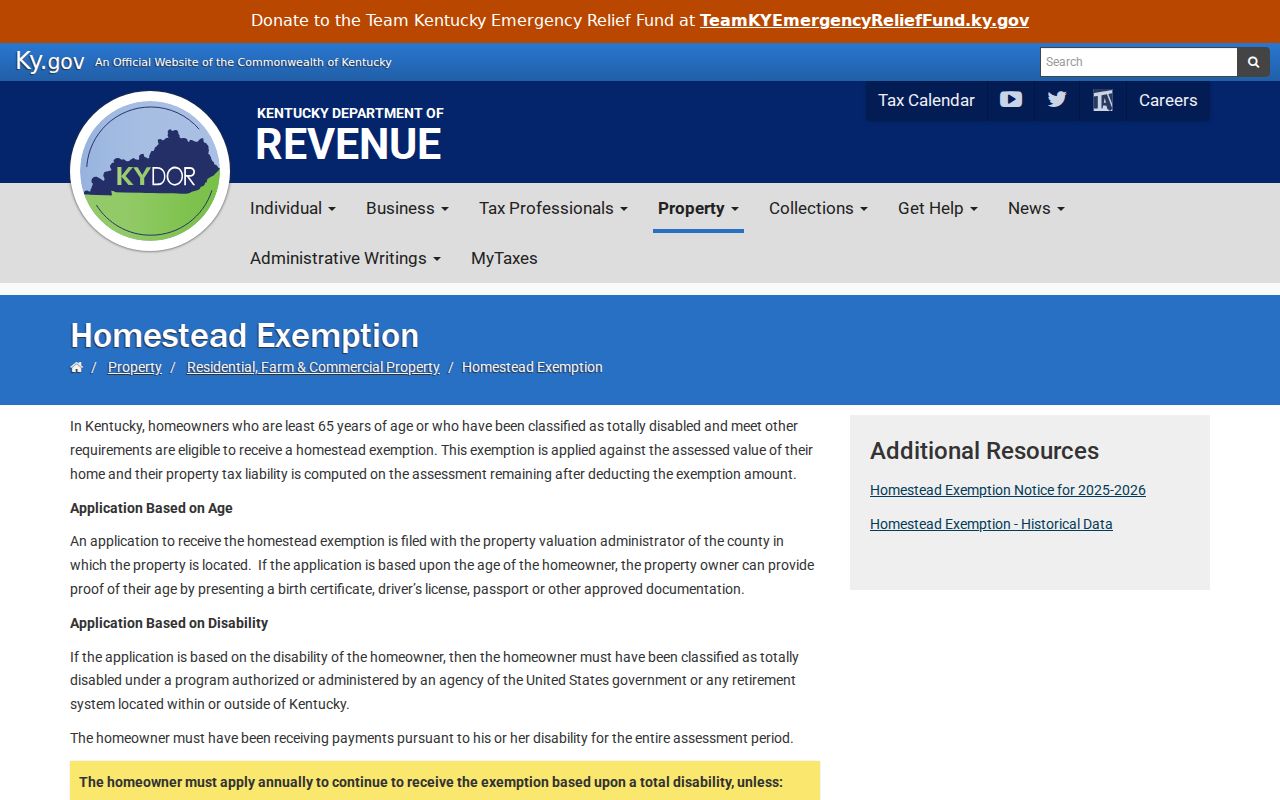
That statewide figure does not replace a Robertson application or the local PVA's eligibility decision.
Eligibility, residence, ownership and application evidence all matter. Ask the PVA for the current form and the effective tax year. An exemption does not transfer automatically after a purchase. A change in circumstances can end it. Farm land may qualify for agricultural-value treatment. That treatment stands apart from an ordinary residential homestead exemption.
Appeal the Assessment, Not the Tax Rate
Kentucky's property-tax calendar keeps valuation disputes separate from rate questions, and Robertson County follows the same statewide sequence.
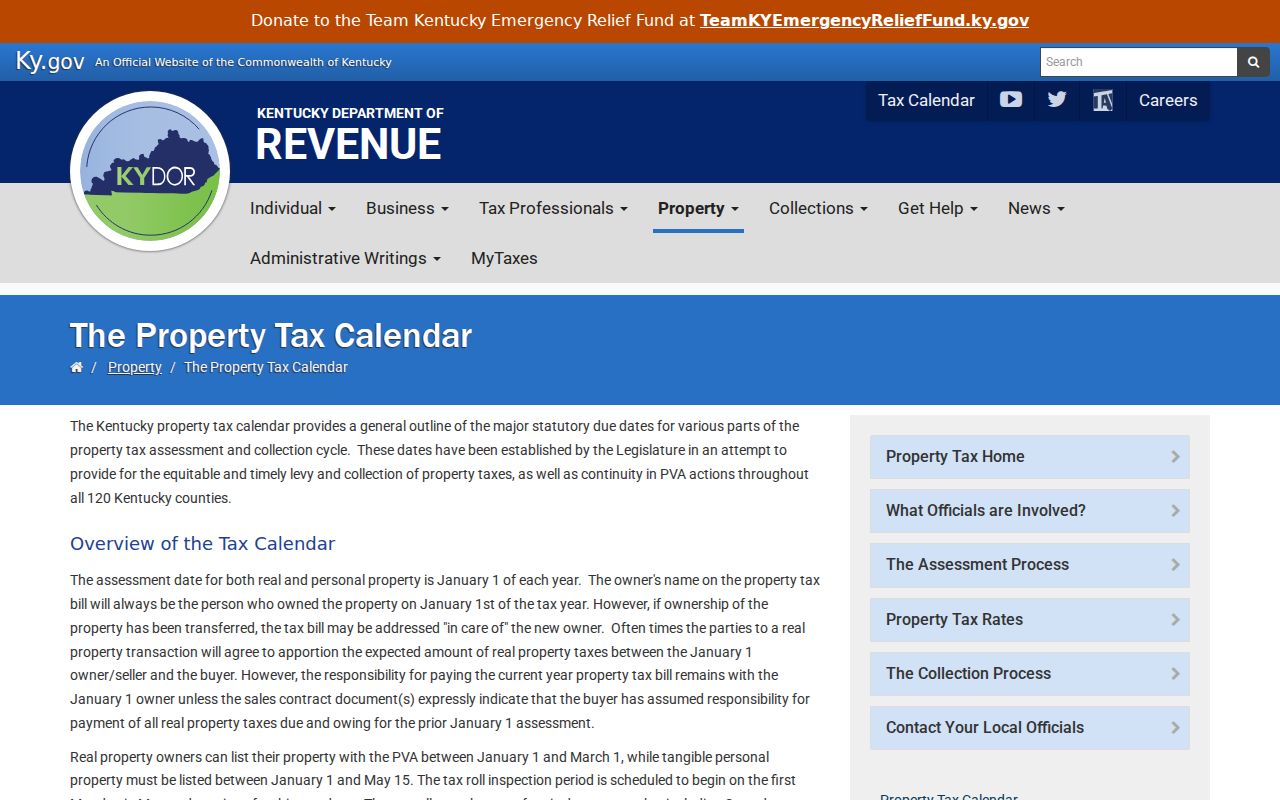
Real property is listed and assessed as of January 1. The roll is open for a 13-day inspection period beginning on the first Monday in May, and the taxpayer must first hold a conference with the PVA before appealing to the county board of assessment appeals.
Prepare comparable sales, photographs, a recent appraisal or other evidence tied to the valuation date. Ask the PVA for the current inspection and conference schedule because calendar dates move each year. The PVA does not set the tax rates, and disagreement with the resulting bill amount alone does not identify an assessment error.
Deadline matters. Contact the Robertson PVA before the May inspection window closes and preserve proof of the conference and appeal filing.
Mount Olivet Has a Separate City Tax Layer
Mount Olivet bills property owners on a separate municipal track. Ordinance 2025-T-1 adopted the PVA/equalized assessment for the city. It levied 0.253 per $100 of real-property valuation and 0.2799 per $100 of tangible property. The 2025 city bill came due November 1. Pay it at the City Hall office or its deposit box. None of this appears on the Sheriff's bill. That bill carries only the county, school and special-district amounts.
Keep the ordinance year and its units exactly as published. For a different year, start with the current bill, rate ordinance and payment record. They come from Mount Olivet City Hall at 54 E. Walnut Street. Bear in mind one caution. A Mount Olivet mailing address alone never proves the land sits inside city limits.
Rate Books Help Explain, Not Replace, the Bill
The Kentucky DOR rate book splits rates by countywide, school, municipal and other taxing districts. That breakdown explains the bill. It does not replace it. Match the right district and year against the assessment's taxable base. Then go back to the Sheriff or City Hall for the actual account. Resist adding figures expressed in different units into one unexplained percentage.
Bills move for many reasons: assessment shifts, exemption changes, classification, district boundaries, rate changes or penalty timing. A recorded deed's consideration answers a different question altogether. It may describe a transfer that was nominal, gifted or otherwise off-market. For market value, an independent appraisal is the right instrument, not the tax roll.
The Four-Year Inspection Cycle Adds Context
Kentucky's real-property framework puts physical inspection on a four-year cycle. Robertson County's PVA keeps building characteristics, photographs and sketches as part of the assessment function. A jump in improvement value may reflect updated property information. It may also reflect a newly recorded sale. Ask which facts and tax year stand behind the figure.
Read the parcel card in pieces. Compare land, improvement and total values separately, and note class, exemption and any agricultural-use treatment. A large year-to-year difference can come from construction, demolition, a parcel split or classification. It can also come from corrected characteristics, an exemption change or reassessment. The tax record alone cannot say which event occurred. Pair it with the PVA explanation and, when relevant, the deed or state permit route.
In an appeal, photographs and recent comparable sales should connect to the January 1 valuation date. Keep copies of everything submitted. Note when the conference took place.
Older Robertson Tax Evidence Lives Offline
Robertson County's older tax evidence survives mainly on paper and film. The Kentucky Room holds assessor books for 1872–1882 and tax lists for 1883–1891. It also keeps deed microfilm and local newspapers. Those sources can place a name in a historical tax context. Presence on an old tax list is not complete title proof.
Remote research runs through the KDLA request portal. The portal accepts tax and deed research requests. Give county, names, an approximate year and any book/page or land description. The published estimate runs four to six weeks. It carries a $20 in-state or $25 out-of-state nonrefundable research and copy fee, plus possible additions.
Transcribe each historic entry exactly as the source presents it. Record the book year, page, district, owner spelling, acreage, property class and valuation. Then set the entry beside a deed, probate record or later assessment. A changed amount may trace to an improvement, parcel division, inheritance or classification change. So do not label it a sale without a matching conveyance.
Keep the source image or page citation with every historic tax transcription. That lets another researcher verify the year, district, spelling and valuation context.