
Read Robertson County Property Value Fields Apart
The Robertson County PVA keeps the assessment roll, ownership changes, GIS data, and building details. Always name the parcel and year. A current assessment and an older deed consideration are not interchangeable, so a value request should specify exactly which figure you need. Ask staff to label each number rather than handing over one unexplained total.
| Value | What It Is | Where |
|---|---|---|
| Assessed value | The PVA figure placed on the assessment roll for the stated year | Robertson County PVA |
| Taxable value | The amount remaining after an applicable exemption or adjustment | PVA assessment and tax record |
| Sale consideration | The amount or consideration stated in a recorded transfer, when shown | County Clerk deed or transfer record |
| Land and improvements | Separate components to request when the PVA maintains the split | PVA parcel response |
Kentucky real property is assessed at fair cash value as of January 1. That tax-law standard does not make the roll a live offer price. Building condition, the assessment date, exemptions, and the nature of a transfer can all make the recorded figures differ.
Request Robertson County Assessment Values from the PVA
Robertson County publishes no PVA property-search interface or parcel card. Start with the official PVA page, call (606) 724-5213, or visit 26 Court Street in Mount Olivet. Bring specifics. Give the street address, road spelling, and postal locality. Also provide the parcel number if known, owner name, acreage, and a deed reference. Then ask for the assessment year, owner of record, situs and mailing fields, and parcel or tax number. Request land value, improvement value, total assessed value, taxable value, exemptions, and building characteristics. Ask for the legal description, map or sketch, and deed reference. Each field keeps one value from being mistaken for another. Log the gap. If staff cannot supply a field, never treat a blank as zero.
Note: A rural route or Mount Olivet mailing address may need an old road name, nearby landmark, or legal-description clue to match the parcel.
The official PVA page capture confirms the local valuation office and its assessment functions.
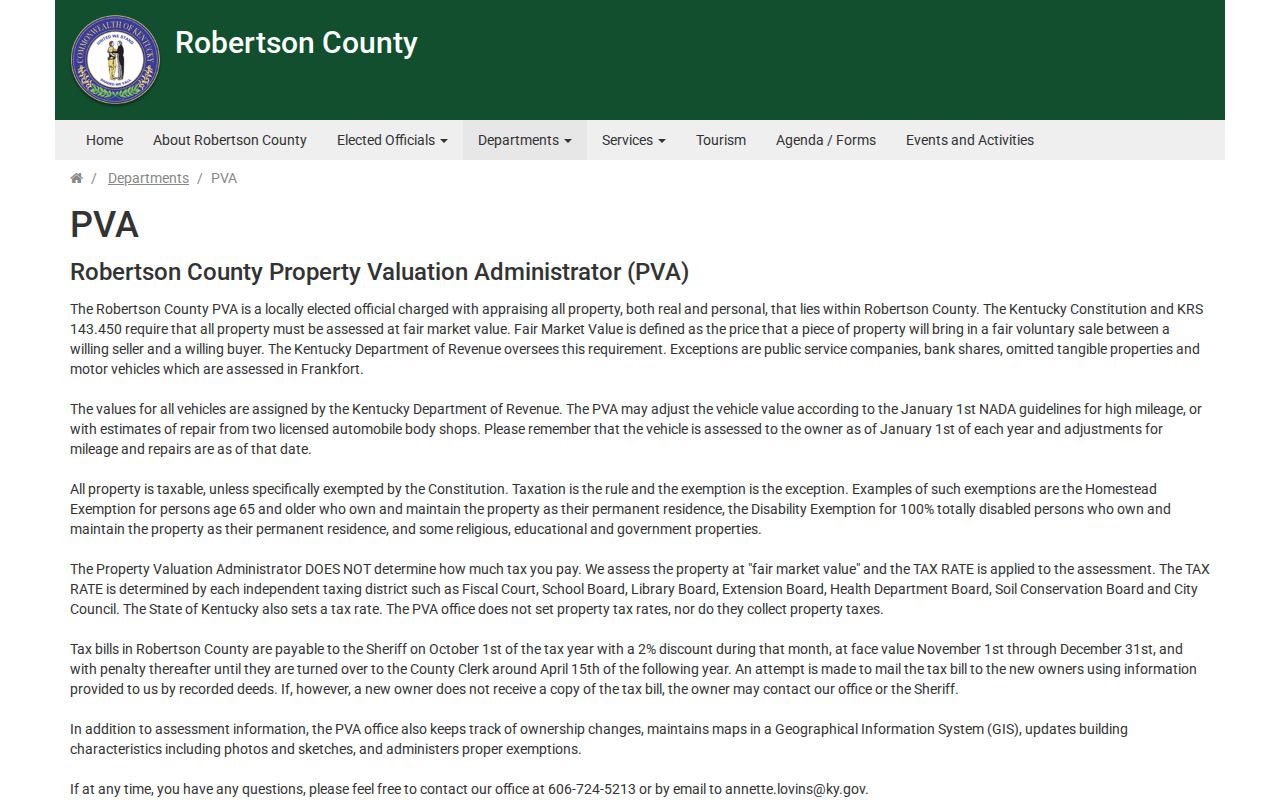
The county site describes the office, not parcel cards. Because no parcel-card search sits behind it, request the parcel's dated value fields directly from the PVA.
Robertson County Property Value Uses a January 1 Date
The Kentucky property tax calendar explains the statewide rhythm. Real property is assessed as of January 1. The county roll is generally open for public inspection for thirteen days beginning on the first Monday in May, excluding Sundays, and a taxpayer who wants to contest a value must first hold a conference with the PVA during that inspection period.
| Stage | Record meaning | Reader's check |
|---|---|---|
| January 1 | Assessment date for the tax year | Match the value to this year and parcel |
| May inspection | Public review and first PVA conference period | Check the DOR calendar for current dates |
| Later tax cycle | Bills use the certified assessment and applicable rates | Keep valuation meaning separate from bill payment |
Value fields and tax bills answer different questions. Payment, delinquency, and appeals belong to the county tax process, so confirm current-year rules with those offices.
Check a Robertson County Property Value Step by Step
Start with parcel identity. Keep every number attached to its source date. The PVA and the Clerk answer separate parts of the question, so a clean comparison needs both offices whenever a sale figure matters.
- Ask the PVA to resolve the address or legal description to the exact parcel number.
- Request land, improvement, total assessed, and taxable values with the assessment year.
- Ask which exemption or classification explains any difference between total and taxable value.
- Use the County Clerk's deed index to find the matching transfer and read its consideration, date, parties, and legal description.
- Compare like dates and the same legal parcel; document any split, combination, or changed improvement.
- Assessed value
- The value assigned on the PVA roll for the assessment year.
- Fair cash value
- Kentucky's assessment standard, often described as the price property would bring at a fair voluntary sale.
- Taxable value
- The base remaining after a qualifying exemption or adjustment, when one applies.
- Consideration
- The amount or value recited in a transfer; it is not always a simple open-market sale price.
Compare Robertson County Value to the Recorded Deed
The County Clerk records deeds and other land instruments. The Clerk's online-records page points to eCCLIX. Robertson documents are online from 1980 to current, though the eCCLIX availability screen should be checked by document type. Older books live at the courthouse. They can also be reached by written request, library microfilm, or archives assistance. An arm's-length sale makes consideration a dated market reference. A family transfer, quitclaim, estate distribution, multi-parcel deed, or nominal consideration may not. Confirm the legal description and whether the amount covers only the subject tract before lining a deed up against a Robertson County property value.
Exemptions Change Robertson County Taxable Value
Kentucky's homestead exemption runs through the PVA. The Department of Revenue homestead page lays out the statewide program for qualifying property owners. An exemption trims the taxable base without touching the house, the acreage, or a past recorded consideration. Request both total assessed and taxable value. Ask which exemption is reflected. Never read the gap as appreciation, depreciation, or a recording error until the PVA explains its cause. Eligibility and amounts can shift. Follow current official guidance rather than an older tax notice.
Note: Compare parcels on the same assessment year and property class before drawing a conclusion from their taxable-value difference.
Mount Olivet Adds a City Rate, Not a New Appraisal
Mount Olivet's 2025 tax ordinance adopted the PVA or equalized assessment and levied 0.253 per $100 on city real property, with city bills due November 1, 2025. The ordinance supplies a rate and a billing date, not a value history. The city never runs its own appraisal. Confirm the parcel sits inside city limits first. A 41064 postal address does not prove that. Check city-boundary filings, and ask the PVA or City Hall to confirm jurisdiction. Sardis is different again. It crosses Robertson and Mason counties, so Mount Olivet's rate and due date must never be applied to a Sardis tract.
Build a Robertson County Value Trend Without Guessing
A reliable trend starts with the parcel. You need two or more dated assessments for the same legal description. Record land, improvements, total assessed value, taxable value, exemption status, and building changes for each year. Pair a deed consideration only after confirming it covers the same tract. Divide the parcel, and comparability breaks. Combine or improve it, and the numbers need adjustment too. The county publishes no parcel-value history card. Neither Mount Olivet nor Sardis posts a value series for its tracts. The honest route is a dated PVA request. Small scale makes a request log valuable. Include the request date, parcel identifier, years sought, fields returned, and any missing values.
Know the Limits of a Robertson County Assessed Value
An assessed value is a tax-roll figure. It is fixed to a valuation date and Kentucky's assessment rules. It carries official weight. Still, it promises nothing about a property's condition, title, boundary acreage, or what a buyer would pay today. A deed's consideration is historical too. It may reflect a transfer that never faced the open market. So treat it as context rather than proof of value.
Value versus price. A Robertson County assessed value supports taxation and is not a prediction of what the property would sell for. Use a qualified appraisal for a current market opinion.
Keep the value record in its proper role. It can support purchase research and estate review. It also helps with comparison of assessment years or a conversation with the PVA. What it cannot do is replace an inspection, a survey, title work, or an appraisal. Each of those answers a different question about the same parcel. Dates make comparisons useful. Save the January 1 assessment year and the date the PVA supplied the figure. Save the execution and recording dates of any deed used for sale context. A later closing may not align with the owner printed on that tax year's bill. Without those dates, two accurate records can look inconsistent. Property class matters as well. Kentucky permits agricultural-use treatment for qualifying farm land. An exemption can reduce taxable value without changing the market evidence behind the assessment. Read land, improvement, total assessed, taxable, class, and exemption fields together. If one field is missing, label the gap. Do not infer it from the tax due.